12/16/2025 • 4 min read
Use Affordances to Optimize Learning Spaces
Discover how design choices help students thrive physically, emotionally, and cognitively
It’s intuitive that learning happens anywhere, but some spaces foster learning better than others. What distinguishes an effective learning space, one where students and teachers want to be? Thoughtful, intentional design. Human performance is enhanced by spaces that provide physical, emotional, and cognitive affordances. From Haworth's research and expertise designing workplace and education spaces, we know that tailoring spaces to meet the specific needs of individuals in these three affordance categories helps optimize the way students learn and work. Let’s look at the role of each affordance in educational settings.
Physical Affordances Ensure Spaces Where Students Fit In
Physical affordances shape how people perform and feel in a space. Spaces that are comfortable and adaptable support engagement and well-being. Spaces can also have the opposite effect. Anyone who’s ever sat in the cramped middle seat on an airplane or shivered in a too-cold movie theater knows firsthand how physical affordances affect one’s experience.
When we design physical affordances for schools, we consider a student’s relationship to the learning space. Acoustics, lighting, air quality, and thermal comfort all influence their ability to learn and socialize. These elements of the physical environment affect student well-being.
Physical affordances also take shape as furnishings that create an atmosphere where students can feel relaxed and find a spot where they fit in. For example, whether they’re short or tall, need to sit or stand, a range of options allows each student to choose the place that suits them best. Over the course of single day, an individual may move through dozens of positions and postures. When the learning environment is designed to address students’ physical needs to move throughout the day, students can better focus their attention on learning.
The faculty’s relationship to the learning space is another consideration for physical affordances. It’s important to design spaces that meet present needs and can adapt for future needs as teaching methods evolve.
Flexible physical spaces allow teachers to reconfigure, expand, move, or downsize furnishings as needed. For example, a hub space for entrepreneurial students at the University of Calgary includes areas for large group activities, as well as ancillary spaces for breakouts for a few individuals. The space adapts to support a variety of learning activities.
Emotional Affordances Foster Connection
Emotional affordances foster a sense of belonging, which is essential for students to thrive. Spaces need to support them in the moment and over the course of time, as they work individually and collaborate together. Building a sense of connection through learning space design should not be underestimated, as it has a key role in student success. Studies show that a students' sense of belonging contributes to improved academic outcomes, increases in continuing enrollment, and positive mental health outcomes.
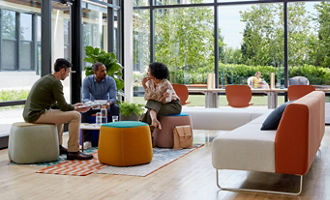
Gathering spaces are often seen as a primary way to provide emotional affordances that support students as they connect socially, think together, participate in activities, and inform each other. In both formal settings (like classrooms and labs) and informal ones (such as lounges and cafeterias), intentional design choices contribute to making spaces comfortable and calming, putting students at ease.
Cognitive Affordances Help Students Perform Their Best
Cognitive affordances create environments that minimize distractions and enhance learning, empowering students to perform their best. Have you ever noticed you do better work in some places compared to others? Our research shows a direct connection between space design and how those spaces enhance mental functions like focus, planning, learning, and memory. This applies to both work and learning spaces.
When we design environments that leverage the brain’s interaction with its surroundings, we help students perform their best. We see a cognitive affordance in action when students have better recall of earlier lessons as they return to the same space for each class. Another is when collaborative learning is enhanced by tools that allow students to draw and share ideas. Cognitive affordances are any design elements that facilitate learning.
When designing learning spaces, no single solution can accomplish everything. However, intentional design choices that incorporate physical, emotional, and cognitive affordances optimize learning spaces so students can perform their best
More on Education Spaces
Learn more about creating modern spaces that enhance the educational experience. Explore Haworth’s solutions for creating dynamic, flexible learning spaces.