Trend #2 - Materials

Milan Design Week 2025

Dualities, contrasts, nuanced opposing pairs – this theme has already come to define our time in Milan. 

During our second day in the city, we explored materiality. The contrasts we found during our exploration of colour continued. We encountered several installations that examined the relationship between the material and the immaterial. What does absence mean? What is the impact of emptiness? How can form be given to that which is formless?

The immaterial, the intangible, the formless – studios like Stephen Burks Man Made, AMDL CIRCLE, and Google explored this upside-down, inside-out sense of materiality. We also sought to understand how creative minds in Milan are connecting materials and emotion; we spoke with Haworth’s own Larissa Sarjeant to discover the overlaps.
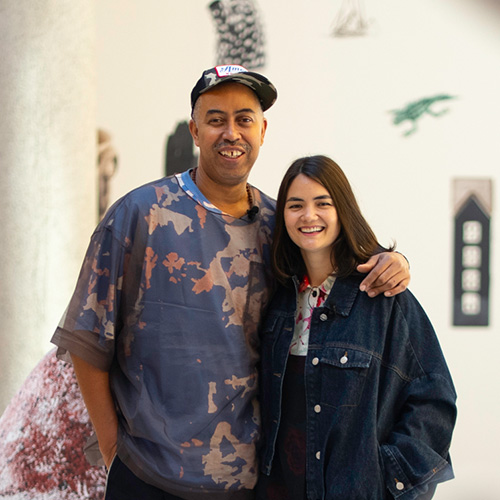
Stephen Burks and Malika Leiper of Stephen Burks Man Made welcomed us to their Particulaire installation for Calico Wallpaper. Particulaire is a panoramic mural of objects Stephen and Malika have collected from their travels around the world. Some of the mementos from the mural were made into standing versions many times larger than their real-life counterparts, creating what Malika described as a ‘larger than life experience.’

‘One of our favourites over here is the Hand of Fatima – which, in reality, is only this big.’ Malika said, indicating a true size of about 6cm. ‘A lot of the objects are really miniature.’ 

Through Particulaire, Stephen and Malika were able to give tangible form to intangible memories – a theme that has come up before in their work. ‘Making the immaterial material comes from our project Spirit Houses,’ Stephen said. ‘We were really wondering during the pandemic, when we couldn’t gather as communities, we couldn’t mourn – we were wondering, how do we deal with spirituality in the contemporary home?’

‘How do we deal with loss and grief?’ Malika added.

Spirit Houses thoughtfully enclosed emptiness. In doing that, ‘you create space to be a little more empathetic, right?’ Stephen said. ‘A little more modest, a little more humble. Because you realise that there’s a lot more to life than just you.’


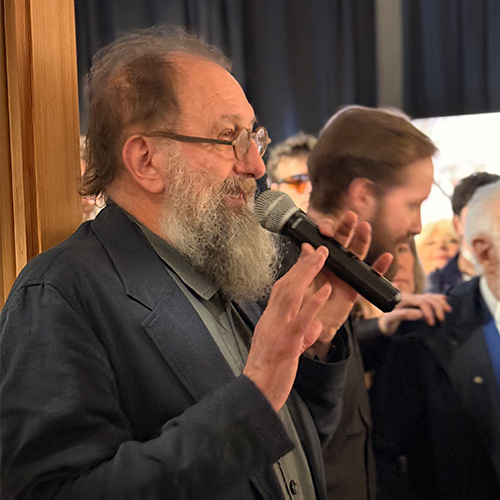
AMDL CIRCLE, the studio of Michele De Lucchi, welcomed visitors to ‘Rituals of Making.’ The event celebrated the opening of Produzione Privata’s art gallery right beside AMDL CIRCLE’s studio. For over thirty years, Produzione Privata has been the home for Michele’s experimental projects that carry on the spirit of Memphis. 

Keeping to Michele’s signature simplicity, the gallery mostly consisted of raw plywood displays and frames containing artwork and furniture. Michele’s approach to materiality is a consistent inspiration for us. His furniture and art pieces don’t usually have much ornamentation – but at the same time, they are not austere or overly minimal. Instead, there is warm simplicity to each piece that lets the material – usually a light wood – become the protagonist. 


Google’s exhibition at Fuorisalone was called Making the Invisible Visible. ‘Composed entirely of sculpted light,’ the installation was a poetic exploration of how the process of creation unfolds as unseen inspirations are slowly transformed into physical products. 

Victor Bourdariat, designer for Haworth Europe, noted how tangible the light felt. ‘It feels like a curtain,’ he said, ‘as if you had material. But actually there is nothing – it’s just light. You can walk right through it. Once you step in, it’s like you’re in a different dimension somehow. There’s a separation between you and someone on the outside, like you’re in totally different spaces.’

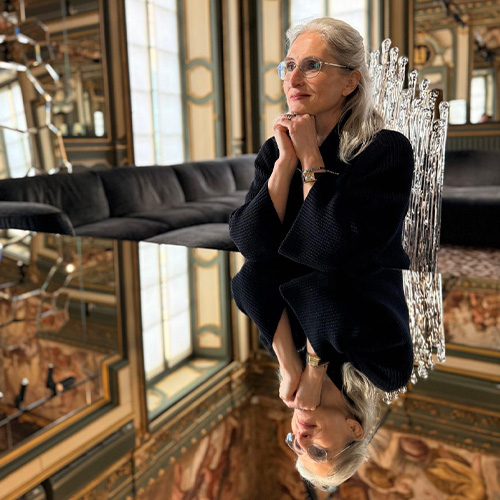
We also spoke with Larissa Sarjeant, Haworth’s Managing Director of Germany, in the beautiful Zanotta showroom. For Larissa, the connection between emotion and materials has to do with the senses. 

‘You walk into a room and maybe the smell is reminiscent of, I don’t know, an experience from the past when you felt really nice – your grandmother’s home or something,’ Larissa said. ‘Materials have a huge influence on how we perceive our surroundings.’

Larissa touched on something that we all seem to long for: a sense of safety. ‘You want to feel comfortable and cosy and safe,’ she said. ‘As humans, you always want to feel protected.’ 

With thoughtful materiality, a space can be transformed into a refuge – another example of enclosing an emptiness in order to create and protect something deeply meaningful inside. 


Our day exploring materiality became a day exploring its opposite. But by taking that step back, we were able to ask fundamental questions about what materials can do. Google showed that light can become a tangible experience. Larissa directed us to the emotional aspect of materials, which is founded in appealing to the senses and creating a sense of sanctuary.

Michele De Lucchi’s playful simplicity allowed materials to show their true character. And Stephen Burks Man Made spoke of using materials to protect an emptiness – which creates a space for grief, empathy, and humility. 

The immaterial made material, the intangible made tangible, the formless given form: Milan’s contrasts continue. 

Check back in tomorrow as we explore the conversation around AI in design!  


Listen to article

Note, if the audio player does not show, you may need to accept preferences cookies to enable the player.