The story of your spine
Your spine is busy.
All day, every day, your spine works and works and works with one goal: supporting you. It can be a thankless job, really – and sometimes you don’t make it easy for your poor backbone!
You may plop down in bad chairs that offer little support for your back. You might not stretch enough. You could spend hours hunched around your phone or laptop. Even if you have an ergonomic chair, you might sit in unergonomic positions like some sort of collapsed human pretzel.
(Let’s pause for a moment as everyone sits up and adjusts their postures.)
In honour of the often unappreciated wonder that is the human backbone, today we’ll discuss the Story of Your Spine.
What your spine is made of
Your spine is a marvellous stack of bones and pillows.
The bones are your vertebrae; you were born with thirty-three of them, though some have fused by now (unless you have found this article as a remarkably early reader).
The pillows are your discs. These are squishy little cushions that absorb shock and prevent your powerful vertebrae from grinding against each other.
It gets even more marvellous. The inside of your spine is hollow. Through that tunnel, your spinal cord travels, like a silver string looped through a necklace of seashells. Protected by the spine’s armour, the spinal cord carries precious information between your brain and the rest of your body.
The magical S-curve
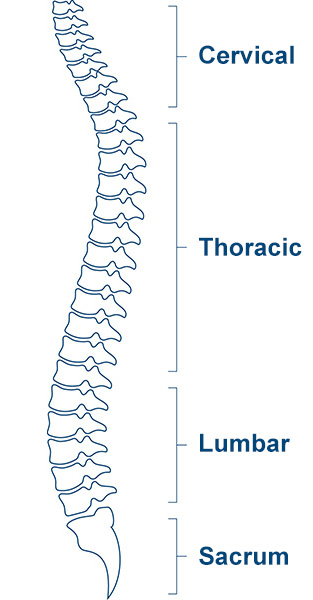
Your spine is organised into 4 regions: the cervical, the thoracic, the lumbar, and the sacrum. Your spine is a marvellous stack of bones and pillows, but from the side that stack does look a little wonky (think of a tower in a Hayao Miyazaki movie).
The spinal regions gently curve in different directions – the cervical inward, the thoracic outward, and the lumbar inward – making an S-shape.
That S-shaped curve is the magic that gives your spine its strength! According to Cedars-Sinai, the S-shape ‘allows for an even distribution of weight and flexibility of movement’.
Now you know what your spine is made of and how it looks. What does it do?