10/09/2024 • 5 min read

Bees, beauty, and biophilia

Thoughts on ecology – a video interview with Claudia Zanfi

by Alex Przybyla

Biophilia is a familiar topic in the world of workplace. As architects, interior designers, and product manufacturers, we are always asking: How can our workspaces connect us more to the natural world outside – and how can we bring more of the outside world in?  

Claudia Zanfi has some ideas – but before we introduce Claudia, let’s talk about one of her passions: bees.

Honey bees are master foragers. While other pollinators are narrow and specialised in their food sources, honey bees are flexible bon vivants, sampling nectar and pollen from all across nature’s eclectic buffet. What the bees collect from that vast and varied range of flowers is then poured into collective projects that benefit the whole community.

Claudia Zanfi can relate. She has found design inspiration in a dizzying array of disciplines – including beekeeping. She is also an art historian; the curator of photography archives such as BILL OWENS (SF); the director of nonprofits like GREEN ISLAND MILANO; a garden designer and botanic consultant; a visiting professor at universities in Milan and London; and the founder of SWARM, a collective of women from a range of disciplines, including photographers, artists, designers, botanists – and beekeepers. 

This vast and varied experience has given Claudia a unique perspective on the dialogue between humans and nature. For those of us looking to bring more nature into workplaces, Claudia is a veritable hive of inspiration.

We visited Claudia at the SECRET GARDEN installation to talk about bees, design, and the dialogue between humans and nature.  

The SECRET GARDEN installation

GREEN ISLAND installed the SECRET GARDEN in Milan’s Porta Garibaldi train station. (Porta Garibaldi is near the iconic Bosco Verticale tower, a renowned symbol of urban greening whose design was partly inspired by one of Italo Calvino’s novels.)

As the Director of GREEN ISLAND for over twenty years, Claudia has used installations, exhibits, and art projects to spark dialogue between urban communities and nature.

The decades-long conversation that has unspooled carries insights that we can apply to the world of workplace – and an apt symbol of that conversation is the humble, hard-working honey bee, a guest in gardens worldwide. 

Love for the local: inspiration from our own gardens

‘One of my highest passions, let’s say personal affections, is gardening,’ Claudia said. ‘As a garden designer, I did study a master's degree in garden design and since then, even if I am an art historian, I started to look closer, closer and more close again to the – what is important for the garden, what is important for the flowers?’

This philosophy of close-looking at the nature around us is a rich opportunity to find local biophilic inspiration. It’s all too easy to miss what’s right in front of us. Claudia’s own experience opened her eyes to the ‘fascinating’ world of bees.

‘Pollinators are the most important insects, animals, as we want to call it, for everything that surrounds us,’ Claudia said. ‘Fruits, vegetables, trees, plants, flowers. Everything, everything.’

Biophilic philosophy has encouraged this embrace of the local since its inception. Inspiration is all around us, wherever we may live and work – even in our own gardens. (Or, for those of us in urban communities, in our window planters or balcony gardens.)

Those local touches might be expressed by using local plants for the office greenery, adding decorations inspired by local geography, or bringing abstract elements that thoughtfully connect to local history. Or – as Claudia alluded to during our interview – a space can subtly embrace the local by using a colour palette drawn directly from the surrounding area. 


The goal of biophilia: giving people beauty

The SECRET ISLAND had a simple aim: to ‘give back beauty’ to everyone who passed by. ‘This is something that is very interesting for the eyes and also for the soul,’ Claudia said, ‘because when you see beauty around you, even if it’s a small place… it goes into you, deep inside.’

Beauty and biophilia are deeply linked. An encounter with nature can fill us with wonder – whether that encounter is standing before a roaring waterfall, smiling at a plucky little flower, or seeing the vivid green of a new leaf on a fiddle leaf fig tree in the office.

The world of bees inspires awe in Claudia. ‘It’s so fascinating, it’s so complete,’ she said. ‘It’s such a perfect world.’

That awe for bees has led Claudia into an unexpected product collaboration.


Working with nature to create works of art

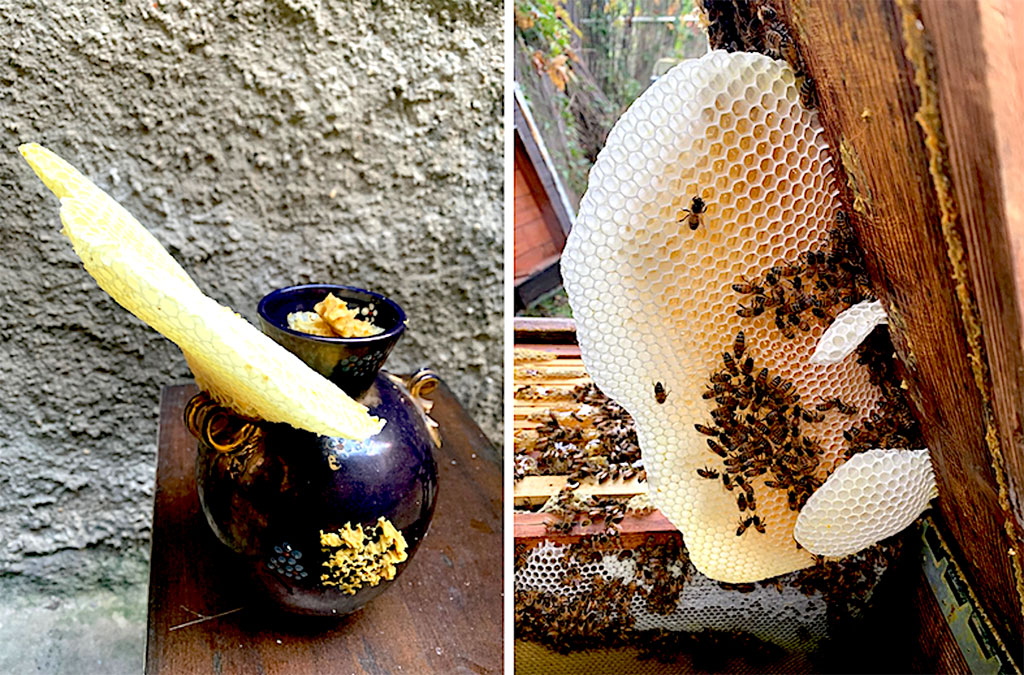
‘With a group that I have co-founded called Atelier del Paesaggio,’ Claudia said, ‘we collect antique vases, or vases from the beginning of last century… and we put the vases into the hive and we let the bees build the rest, to continue the vase.’

That means SECRET GARDEN was an interspecies art installation – a collab between humans and bees. And as beautiful as the vase was, it was only half-complete!

‘And this is not even finished,’ Claudia said, ‘because we need to take it out and bring it here. But eventually they can cover it completely or they can create structures. Bees are perfect architects… Gaudi created the Sagrada Familia inspired by the beehive.’

‘So it's a wonderful world,’ she added.

Biophilia in the workplace might include projects created by nature – like vases adorned by the work of bees. It could also mean local driftwood, locally made ceramics, or even something like local fulgurite, the result of lightning striking a beach and turning the sand to glass. 

Biophilic philosophy suggests that we have an innate longing for nature, and this longing doesn’t go away when we go to the office. Workplace biophilia connects people to the beauty of the natural world, making us healthier, more inspired, and more productive. 

As Claudia showed, we don’t have to look far for inspiration. Biophilia inspired by our surroundings might include plants, colours, or objects from local landscapes.   

Whatever project she pursues next, you can be sure Claudia will be helping people find ways to connect to the broader world, expanding ‘dialogue between humans and all the other living presences – like bees, for example.’ 

Exploring the Creative Mind

Learn from the best. In Season Two, today's sharpest design minds discuss the human-centric future, the end of the global mega-trend, the dialogue between humanity and nature – and more.

Tags:

You May Also Like