15/11/2024 • 12 min read

Leave it be: the joy of Michele De Lucchi

An afternoon with a master designer

by Alex Przybyla

Michele De Lucchi, one of the founding members of the Memphis movement, needs no introduction. His work as a designer, an artist, and a teacher has inspired countless people around the world. It is fitting that his interview needed virtually no editing. As an interview curator my goal is to slim inspiring talks down their essential takeaways; my aim is to bring you, the reader, the brightest gems among gems. In this interview, however, I would be doing you a disservice to remove any of Michele’s comments.

I hope you find his words as inspiring as we did.

The below is a translated transcript of a conversation in Milan in April 2024 between Michele and Haworth’s Victor Bourdariat (Victor was one of Michele’s students at Milan Polytechnic twenty years ago).

Victor Bourdariat: Good morning. Thanks so much, Michele De Lucchi, for receiving us in your studio. It’s an honour to be able to talk to you. We wanted to start with a first question. Let’s try to figure out how to describe your design approach and your concept of work.

Michele De Lucchi: I like to play. I am always joking. I never tell the truth. But when I tell lies, the lies are so big and incredible that everyone immediately realises that they are lies.

And I think that’s kind of the point of design as well. Because design that is always doing the same thing, or applying the same rules – that’s not designing, it’s applying.

Instead, design means to search. Design is always trying to go a little bit further, always trying to break habits and conventions, to step where others haven’t stepped.

Today, it is so important to change. It is so important to see, to understand the nature of change, to understand why we have to change. We have to evolve so quickly. We are at a moment when things must evolve quickly. We know nothing. We don’t know anything. The big problem is that we don’t know how to do it. We have so many problems – from wars to the aggression of people to the climate crisis to social crises to economic inequality – there are so many problems, and the only thing we know is that we have to change, because going on like this doesn’t make sense, it’s wrong.

So how do we change? That is the most important design that we are doing.

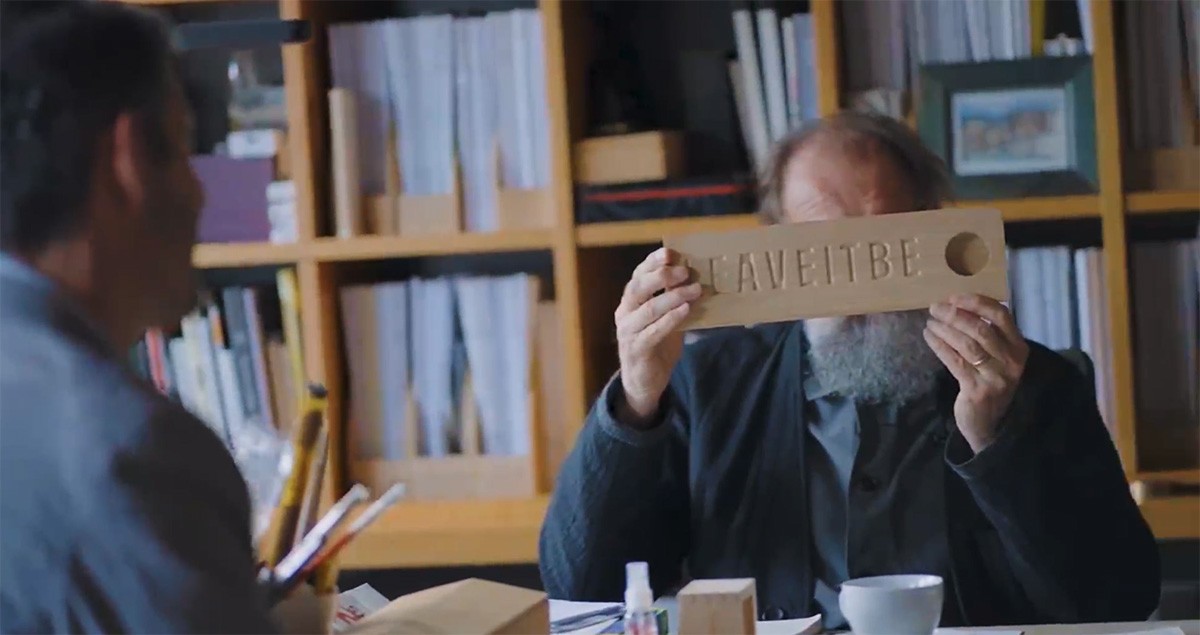
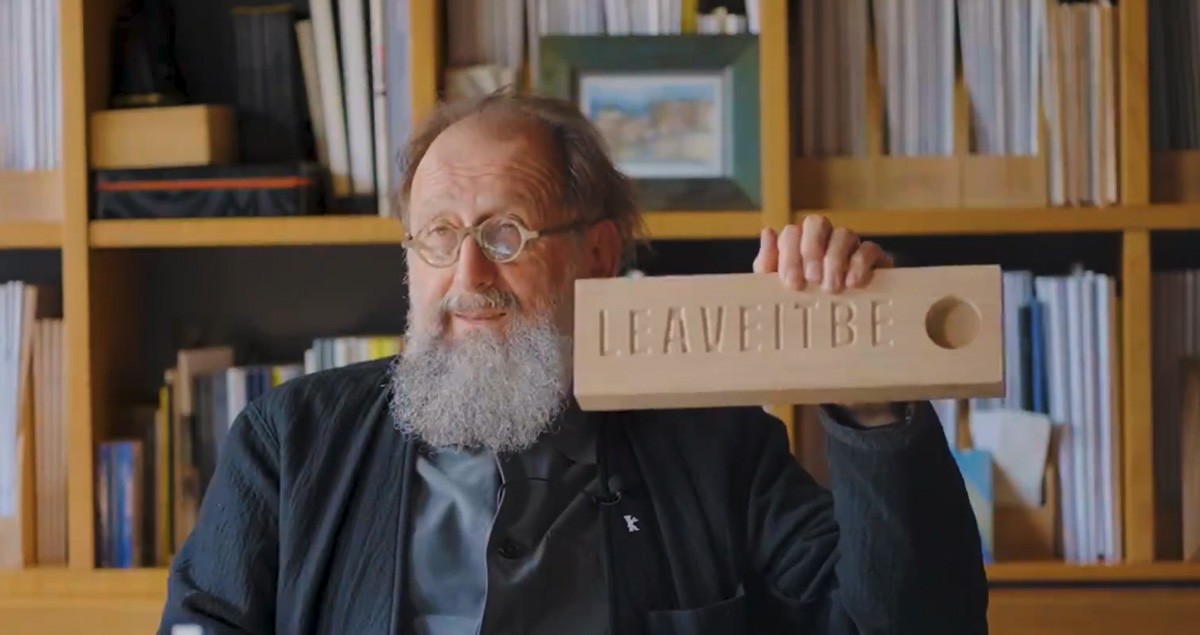
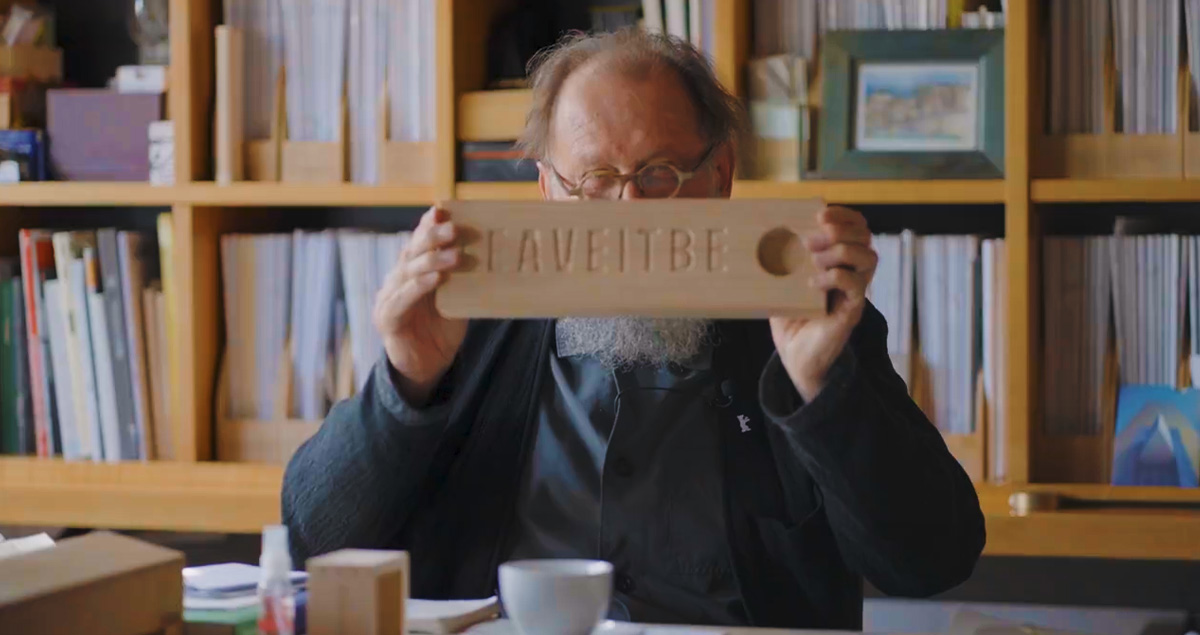
After saying this, Michele holds up a wooden block. The camera angle makes the block cover most of his face, almost obscuring De Lucchi’s small, quiet smile. Three words are etched into the wood: LEAVE IT BE.

MDL: That does not mean not taking care of what is happening. This means knowing how to see ourselves from the outside, knowing how to study ourselves from the outside, how to interpret ourselves from the outside. And this is a great quality we have as humans. We can see ourselves from the outside. We can imagine ourselves when we walk, when we sleep – ah, not when we sleep, no – when we eat, when we talk, when we work. We watch each other all the time. We also sometimes judge ourselves. But normally we look at ourselves thinking that we are actors who move. We interpret the idea of ourselves. We always look at ourselves.

But one thing we never do is look at ourselves in the context in which we are acting. And that is the big step we have to take as humans, as Humanity, as a person, all of us. Learn to look at ourselves from the outside, looking at the context in which we are, the scenario, looking at the stage in which we are acting.

And this is very important especially to be able to understand our relationship with others, with other people, to be able to understand our relationship with nature, to be able to understand our relationship with the city, the countryside, the blue sky, or the rain that is coming.


VB: Going back a little bit to this notion that you mentioned earlier, about play and lies, it made me think about Enzo Mari’s work from a certain era. This approach that you mentioned, how do you see it reflected in the studio and in the work of the studio?

MDL: The play is fundamental. Because you know what you know. They have done scientific tests – those scientists who, when they say something, it’s true – they said, Let’s look at who is more creative. And they made comparisons between those who have a very high intelligence quotient, IQ, and those who have a normal IQ. And do you know who are the most creative? The ones who can play.

Because creativity comes from play. Creativity does not come from intelligence. Those who are smart, too smart, they put one thing after another and they absolutely don’t think to deviate and try a different way. Why? Because it is wrong.

Instead, those who play always go off the main road and always go in search of something. This looking for something is the play. And what holds us together here is precisely this idea: that we have to be creative.

Because what we are missing today are ideas. We’re lacking ideas. We’re always doing everything with the same old system of doing things. You make a system, you produce a chair, you sell it. You succeed, you keep it. You don’t succeed, you throw it away. It’s all about following what we always did without deviating for a moment.

And what we are trying to do now especially is to design this. Our project today is a project of a change of mind, to find a new manner of doing things. A new way of life. A new way of thinking that encourages us to consume differently.

Because we will never overcome consumerism. Because as humans, we always like to look for something better. We will always look for the best – thankfully so. We must therefore try to consume in a better, smarter way. Change is all in our head.

There is a psychotherapist, an American psychologist who said that the greatest invention of our age is to discover that we can change reality by changing our mindset. Changing our way. [For] a psychotherapist it’s clear because he treats people who have problems with relationships, problems with seeing the world, problems with dealing with themselves.

And when a sick person heals, he sees everything differently. But it’s not that he sees everything differently; everything is different. Because the reality, the most important one, is this one here.

Michele smiles and points to his head, then adds:
And here.

He picks up the wooden block and holds it up again: LEAVE IT BE. 

VB: Yes. In fact you’ve already answered my next question because it related to what you said. I wanted to understand: what do you think about the profusion of new objects, new furniture on the market, if you see that as a creative madness, or if it is unhealthy as an endless race of new things, without perhaps asking ourselves the question whether it is still making sense.

Michele smiles and shakes his head.

MDL: Yes – but that’s all perfectly fine. That’s perfectly fine. But it’s always been done. for a simple fact, [that] it has always been done. Objects are useful if they have a meaning. If they do not have a meaning, they are not useful.

So our problem is to give meaning to objects. And to give meaning to objects means precisely to have something in the mind to communicate. If you have nothing to communicate, you don’t need to make the objects. They are not needed. You don’t need it.

However, if you have an idea, something in mind to distribute throughout the world, and it is something valuable, something that others understand, something that others appreciate, and it is something that makes living better for everyone – fantastic. 

VB: Yes. In relation to your academic background, and looking at all the work you’ve done, whether in architecture or in design, how do you feel? With an architect’s soul, with a designer’s soul, with the soul of both. And how is this related to your activities – if you see design as a part of architecture, or if for you it is one and the same?

MDL: This is a beautiful question you’ve asked me, because it is also something I suffered from. Because I always thought, mamma mia!, I’m becoming old and I have not yet decided what to do when I grow up. I have not yet decided if I want to be a designer or an architect or a painter or a photographer or a writer. I still haven’t decided.

And now, when it’s late, I’ve discovered that it’s beautiful this way. It is beautiful to be none, to be none of these, but all of them together. It’s beautiful putting together the knowledge, the skills, the experience of an architect, a designer, a painter, a sculptor, a thinker.

Because looking at the work that we must do today, all of us, it is not specialising, but it is putting together the specialisations. Knowledge is no longer something for the few. Knowledge is something for everyone. The important thing is to understand how to know, and what to do with that knowledge.


VB: So in your career, what would be the moment that was, in your opinion, the most important or perhaps the key moment which fundamentally changed your professional path? Is there something that comes to mind?

MDL: It has not come yet. I’m waiting for it. And here, here it’s coming. It’s coming. Hopefully it will arrive soon, or perhaps – hopefully it will never come!


VB: Thinking about that, your vision of architecture and design, what do you hope to leave as an inheritance for other generations? What do you hope for from the whole work you have done?

MDL: You know, I became a grandfather and I started writing children’s books. These children’s books I do not write under my name. I write under a pseudonym. The pseudonym is Uco de Uchi.

Uco de Uchi is an architect, a painter, an artist, a designer. And Uco de Uchi doesn’t understand anything. But he has a sensitivity and an ability to see and understand how we can invent something for others. How can you make something become useful for others, not only for yourself.

I would really like to leave this: this idea that the role of the architect, the role of the designer, the role of the creative person, is always looking for a solution, an idea to make us feel better. And also a little bit happier.


VB: And looking a bit at the world of design today, are there some thoughts, some schools of thought you disagree with, that drive you mad, that push you to do even more, to, I would say, fight against something that doesn’t feel right at a design level?

MDL: It is all the pessimistic design and architecture. If I were the President of the Republic, of the whole world, I would create a law saying, ‘It is forbidden to be pessimistic.’ With pessimism, we cannot do anything. With pessimism, we don’t face problems because we close ourselves off. We see only the ugly things, we see only the sadness, we see only the loneliness. Pessimism is the most serious thing that exists.

Most of all today, with all the problems we have, also the recent wars, the wars that we are waiting for, that haven’t broken out yet. See, this already brings us to a pessimistic path. And it means not doing anything. 

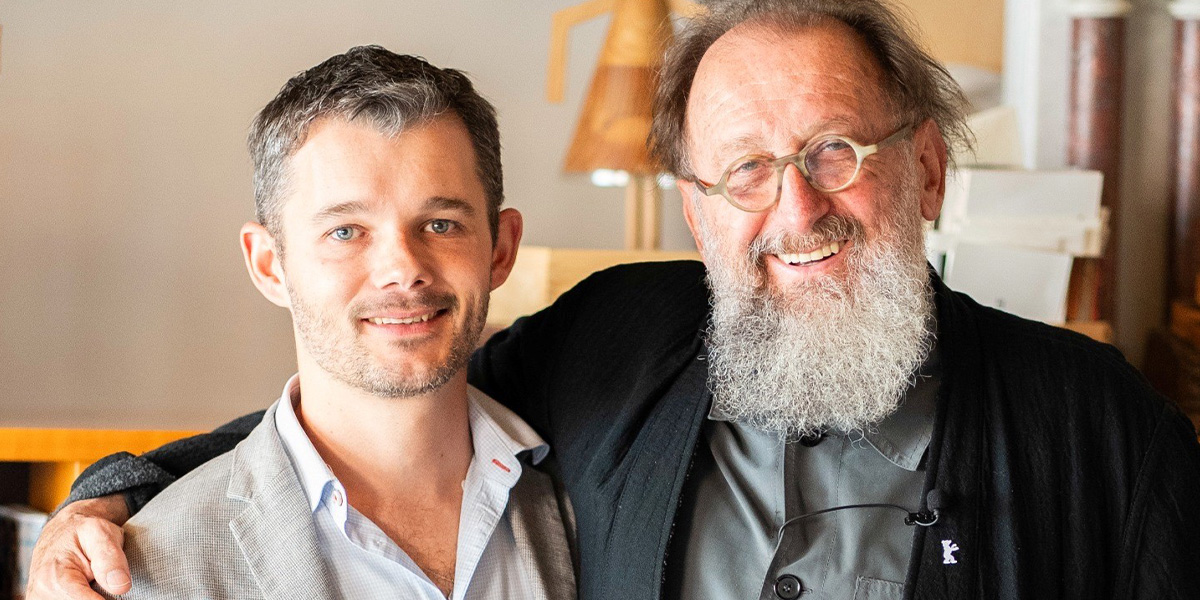
Caption: Victor Bourdariat and Michele De Lucchi

VB: My other question is that I realised it’s now been 20 years since you started teaching. Actually, I had the opportunity to be part of your course with Andrea Branzi at the Milan Polytechnic and I wanted to understand what got you so interested in teaching, what you seek to do with that, and, I would say, which messages would you like to send to young designers and future professionals, playing as the professor?

MDL: Yes. I must say that I did not want to become a professor, because it didn’t seem, it didn’t seem useful to me. It seemed like a waste of time. In the end I am very happy for agreeing to teach and having taught all of those years.

And I am glad to have taught that architecture, design, all the arts – they are not a problem of techniques, they are not a problem of technologies, they are not just applying formulas that we know. They are facing the very problem of who we are, what we want, what our ambitions are. Because architecture, design, all the arts, all creative disciplines are about what we want to become.

And when I meet students who are young, who are full of life, full of desire to live, I learn from them. Maybe they learn something from me. But it is about what we want, what we want from life, what we want from the world.

Here on the lift of the studio, I put a sign. And I wrote, “Don’t give to the client what they ask for. Give them what they never dreamed possible.”

And that is the theme. An architect, a designer, any protagonist in the creative worlds must know how to see beyond, beyond what we would normally like to have, because what we want to have today, with today’s mentality, doesn’t work anymore.


VB: So when you came to the Polytechnic for the first time, you made an observation that really struck me and I would like to understand whether you have changed your idea or not. The first thing you said, you entered the class and you said, Design has nothing to do with Italy. And you started to explain it. I wanted to understand if it is still relevant or if you have changed your mind a little.

MDL: Oh yes, of course, it is very true. It is very true. In the sense that Italy is only one country, one circumstance, in which we like to live well. And the most beautiful project, the most beautiful project for whoever wants to consider themselves as creative, is learning the art of living.

And this is the biggest art that exists. The biggest. In Italy for some reason we like to live well, we like to eat well, we like to be well. We like the sun, we like the beauty of Italy, the forests, the nature, the cities, the towns along the sea, the sea.

The secret is this: what we have to sell is a beautiful idea of life.


VB: Yes, that I agree with, this observation.
MDL: As technicians, we are a disaster. As organisers, we are a disaster. But staying well, we know how to do that.

VB: You have the beauty.
MDL: Ah, yes, something! Maybe.

VB: Well, thank you so much, Michele de Lucchi, for this interview, it is a great pleasure for me, and an honour to talk to you.
MDL: Happy to see you again after twenty years!

VB: After twenty years! Thank you very much.

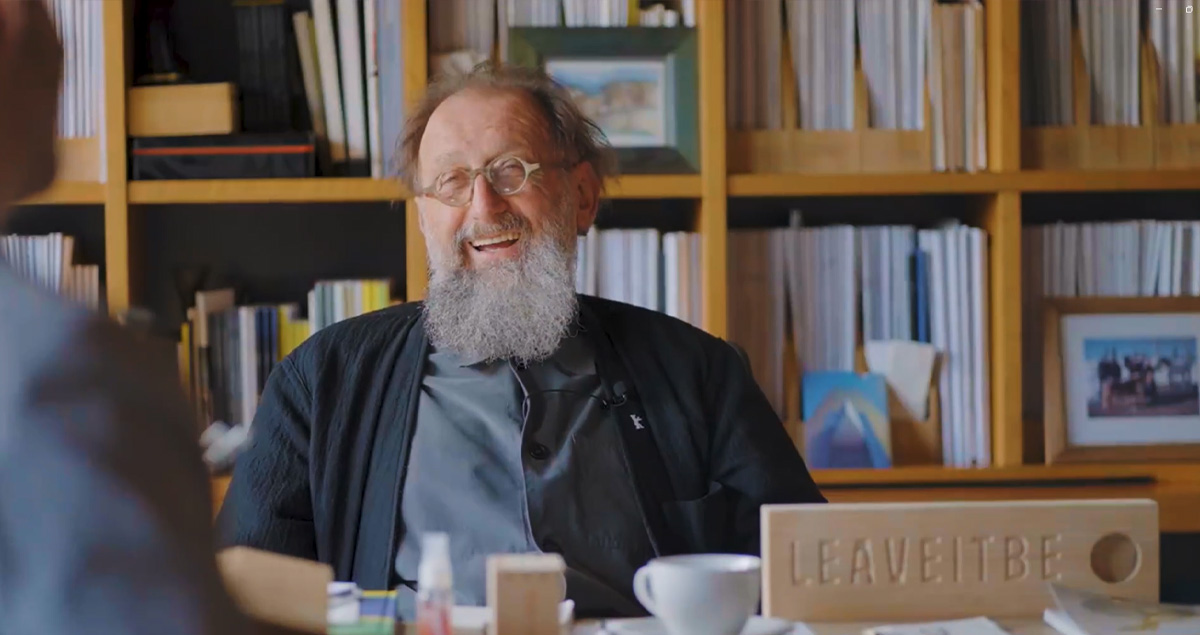
As we conclude the interview, Michele holds up the wooden block once more.

LEAVE IT BE. 
See more from AMDL CIRCLE

Check out the recent talk with Davide Angeli (Deputy Managing Director of AMDL CIRCLE) and Sebastian Herkner from the Haworth Warehouse Experience in Cologne.

Tags:

You May Also Like